



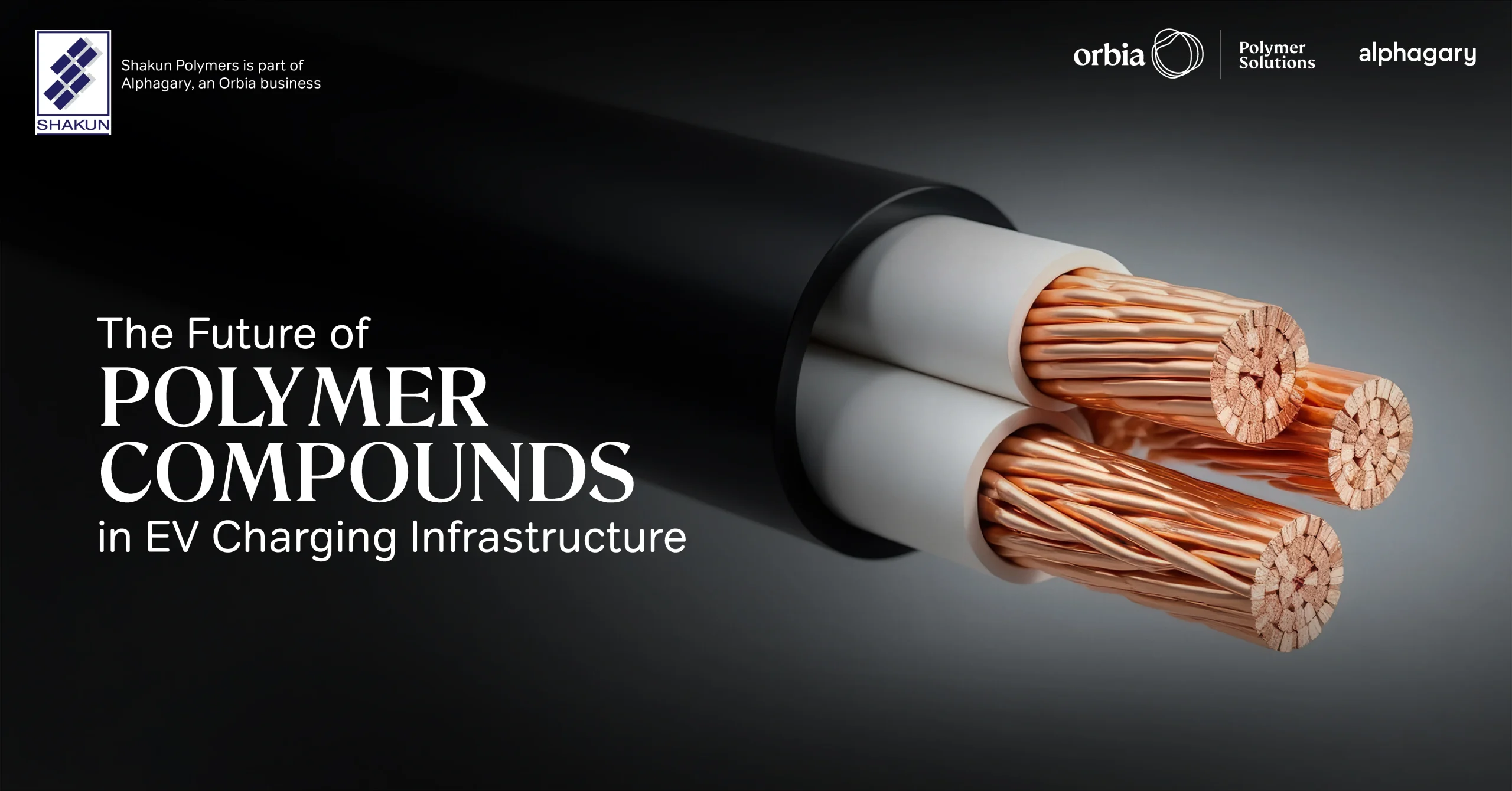
The Future of Polymer Compounds in EV Charging Infrastructure
As electric mobility expands, the cables used across EV systems face increasingly demanding performance requirements. From compact signal wires to larger battery and power cables, different cable constructions require different balances of flexibility, heat resistance, mechanical strength and processability.
This makes material selection particularly important. Polymer Compounds in EV cable applications cannot follow a one-size-fits-all approach. The right formulation depends on cable size, wall thickness, operating temperature and the performance tests the finished cable must meet.
Why Cable Size Matters
Automotive cable ranges can span from very small 0.13–0.35 mm² signal wires with wall thicknesses of around 0.2 mm to 25–120 mm² battery cables with walls exceeding 1 mm. Despite the difference in size, these cables are generally required to meet demanding tests under standards such as ISO 6722, LV 112 and OEM specifications.
A PVC compound therefore involves a careful balance between hardness, flexibility, heat resistance, cold performance and processability. A formulation that works well for a thin-walled 0.35 mm² wire may not be appropriate for a 50 mm² battery cable.
This is why compound formulations are tuned according to cable size and application requirements.
T2 and T3: Managing Heat Performance
Temperature classification is another important consideration. T2 is roughly 100–105°C, while T3 is approximately 125°C continuous, although the exact classifications vary slightly between ISO 6722 and LV 112.
For PVC, T3 represents the upper end of its performance range, leaving limited margin. This makes formulation optimisation particularly important for cables expected to operate at these temperatures.
Long-term heat ageing can also affect compound performance. During ageing, typically evaluated over around 3,000 hours at the rated temperature, plasticisers can migrate towards the surface while stabilisers and antioxidants are gradually consumed.
Thin-wall cables are especially sensitive because plasticisers have a shorter distance to travel before reaching the surface. These grades therefore require low-volatility plasticisers, such as trimellitates like TOTM or polymeric plasticisers, along with effective stabiliser packages.
Balancing Flexibility and Durability
One of the key challenges in developing Polymer Compounds in EV cable applications is balancing mechanical durability with flexibility.
Thin-wall cables require harder and tougher compounds to withstand tests such as scrape abrasion, pinch resistance and high-temperature deformation. At elevated temperatures, a softer compound can allow a sharp edge or pressure point to penetrate the insulation.
Larger battery and power cables have almost the opposite requirement. They need to be flexible enough to bend and route through a vehicle. Cold performance is also important because thick, stiff insulation can crack during winding and impact tests at temperatures as low as −40°C.
The result is a fundamental formulation trade-off: smaller cables generally require harder compounds, while larger cables require softer and more flexible ones.
Extrusion Requirements Change With Cable Size
Compound performance also needs to translate into reliable manufacturing.
Small cables are produced at high line speeds and with very thin walls. Their compounds require low melt viscosity, rapid and uniform fusion, a clean melt and controlled strip force. Even a single gel or filler agglomerate can create a defect in a 0.2 mm wall.
Larger cables are extruded more slowly with thicker walls. Here, the compound needs sufficient melt strength to maintain a round, centred wall without sagging. Heat stability and cooling behaviour are also important for avoiding voids and locked-in stress.
Flame Retardancy and Electrical Performance
Fire performance remains another important consideration. Cable size can influence flame behaviour because larger cables contain more PVC that can contribute to combustion. Larger sizes may therefore require a stronger flame-retardant package, while thin-wall grades have greater scope to preserve mechanical properties.
Electrical performance must also remain within the required limits regardless of wall thickness. Thin-wall cables have less insulation available to provide the required insulation resistance, increasing the importance of the compound’s volume resistivity and the selection of plasticisers and fillers.
The Future Lies in Application-Specific Formulation
The future of Polymer Compounds in EV applications will depend not simply on developing materials with higher performance, but on developing formulations suited to specific cable constructions.
Small, thin-wall cables may require higher hardness, low-volatility plasticisers, stronger stabilisation and minimal filler. Larger cables can prioritise flexibility, cold performance and melt strength, while allowing greater filler content for cost optimisation.
This size-specific approach also affects economics. Thick-wall cables consume more compound per metre and offer greater mechanical margin, allowing greater use of fillers such as calcium carbonate. Thin-wall grades have less scope for fillers without compromising abrasion, puncture resistance and ageing performance, making them leaner and more expensive per kilogram.
Conclusion
As EV cable systems continue to demand reliable performance across different sizes and operating conditions, compound formulation will remain a critical part of cable development.
The most effective approach is not to seek a single universal material, but to optimise Polymer Compounds in EV applications according to cable dimensions, wall thickness, temperature class, mechanical demands, flame behaviour, electrical requirements and processing conditions.
For compound manufacturers and cable producers alike, this application-specific approach can help balance durability, flexibility, safety, processability and cost across the evolving EV cable landscape.